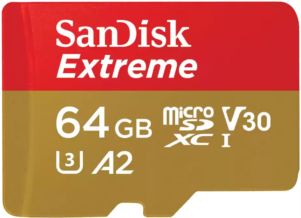
SanDisk is a well-known name in the flash memory industry. Founded in 1988, they developed the first flash-based SSD. They were later acquired by Western Digital in 2016, before being spun off as a public company in early 2025.
SanDisk is a name I’ve long been aware of, and one that — prior to this project — I was biased in favor of. I have a number of single-board computers that take microSD cards, and I typically defaulted to the SanDisk Ultra 16GB for their storage — and most of the time, had no issues with them. And since they’re such a major brand, I wanted to make sure they were properly represented in this project.
I ordered these particular cards in different batches. Sample #1 came from Amazon; samples #2 and #3 came from AliExpress. The packaging was practically identical between the three, but I got slightly different versions from the two sources: both have their product name set to SN64G, and both versions were manufactured in the same month; however, the version I got from Amazon has a product revision of 8.6, while the two I got from AliExpress have a product revision of 8.5.
These cards met all the criteria that I set out for determining what’s considered a name brand card, so their results will be included as part of the name-brand bucket in my results.
On the performance testing front:
- Sequential read: There was a considerable difference in sequential read speeds between the Amazon version and the AliExpress version of this card: the two AliExpress samples scored in the top 5% of all cards I’ve tested (as of the time of this writing), while the Amazon version only scored in the bottom 50%.
- Sequential write: The Amazon sample performed slightly worse than the two AliExpress samples, scoring in the 84th percentile. The two AliExpress samples scored above the 94th percentile.
- Random read: The Amazon sample performed slightly better than the two AliExpress samples, scoring in the top 3% of all cards I’ve tested (as of the time of this writing). The two AliExpress samples scored in the 89th and 94th percentiles.
- Random write: The results here were pretty inconsistent, with the Amazon sample scoring considerably worse than the two AliExpress samples. The Amazon sample scored in the 39th percentile, while the two AliExpress samples scored in the 79th and 93rd percentiles.
As I mentioned above, all three packages were pretty much identical. All three advertise read speeds of up to 170MB/sec — and while none of them made it to that mark, the two AliExpress samples made it much closer to that mark than the Amazon sample did. I’ll note that this is far above the maximum theoretical throughput of 104MB/sec that should be possible under the UHS-I specification, and it requires a compatible reader to get those speeds. The package does say “Compatible with SanDisk Professional PRO-READER SD and microSD to achieve stated read speeds” — and I don’t own one of these. I do, however, have several SanDisk MobileMate microSD readers — and on the package, it says (quite prominently) “Enables SanDisk enhanced UHS-I microSD card speeds”. Sample #1 was tested with one of these readers — and yet it still failed to get anywhere close to 170MB/sec with this card.
These cards carry the U3, V30, and A2 marks — and performance on all samples was good enough to qualify for the U3 and V30 marks; however, none of the three samples did well enough to qualify for the A2 mark. I’ll throw in my standard disclaimer here: my performance testing methods do not align with those prescribed by the SD Physical Layer Specification; it’s possible that they would have performed better if they had been tested under proper conditions. (In addition — no card I’ve tested so far has met the threshold for the A2 mark; however, that’s probably more to do with the fact that I don’t have the proper equipment to test this rather than a failure on the card’s part.)
On the endurance testing front:
- Sample #1’s first error was an address decoding error during round 1,270. It was doing fairly well for quite some time; however, after round 5,505, I shut down the host machine so that I could install some new equipment. When I powered the host machine back up, the card would no longer respond to commands. Up to that point, less than 0.1% of the card’s sectors had been flagged as “bad”.
- Sample #2 has survived 26,199 read/write cycles so far and has not yet experienced any errors.
- Sample #3’s first error was a 6-sector wide address decoding error during round 2,956. It has survived 24,990 read/write cycles in total so far.
November 9, 2025 (current number of read/write cycles is updated automatically every hour)