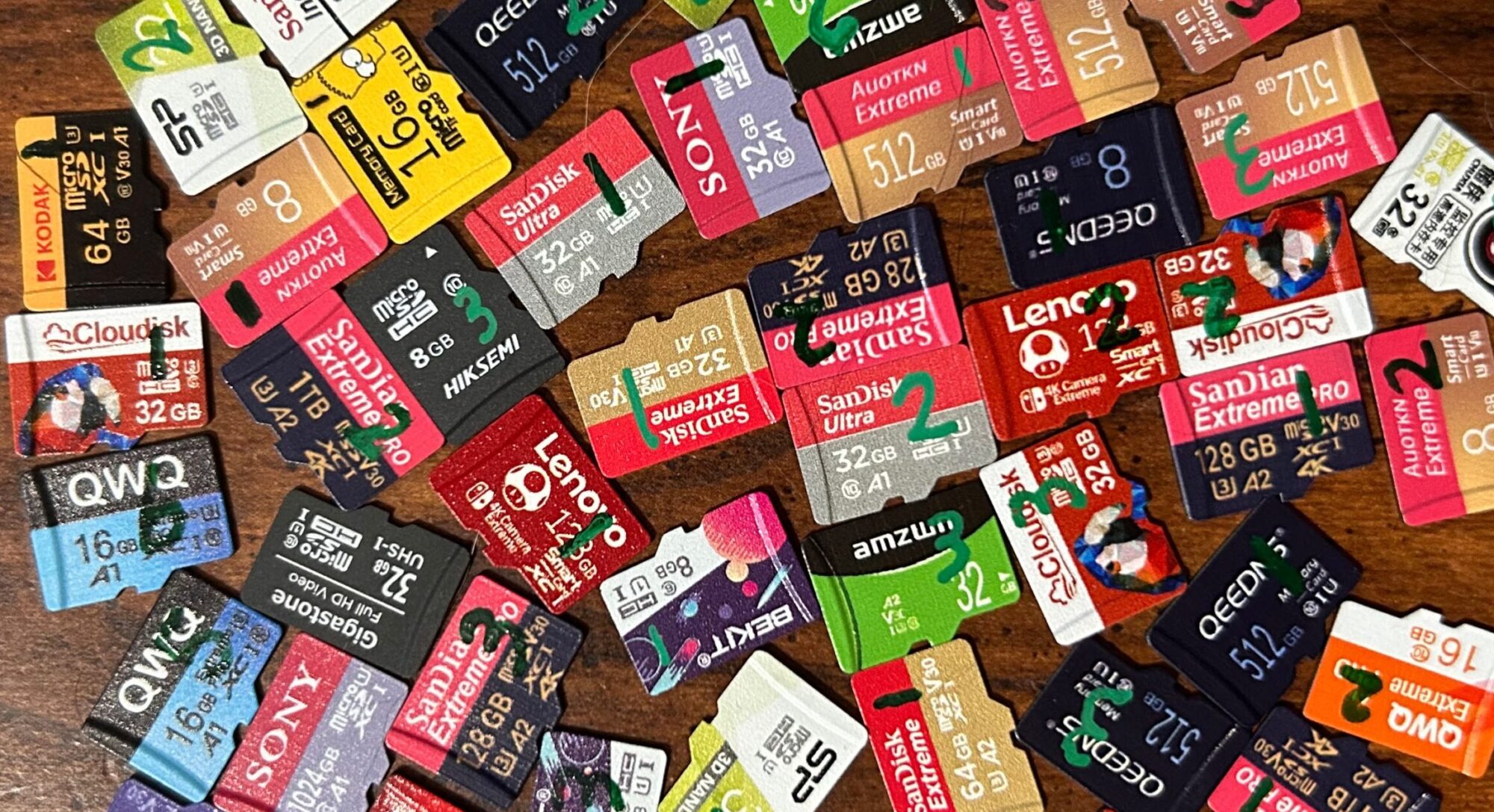
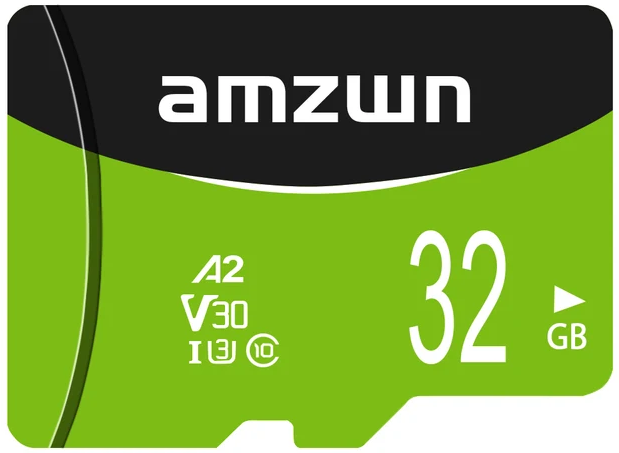
Amzwn is a brand that appeared pretty frequently while I was browsing AliExpress — both when searching for microSD cards, and as recommendations on other products. They appear to come in various sizes, ranging from 32GB to 256GB.
This card fails the criteria that I set out for name-brand cards for a few reasons:
- The card does come in retail packaging, but the packaging doesn’t show any information on the vendor who is selling the card.
- As far as I can tell, they don’t sell anything more than SD/microSD cards.
- As far as I can tell, they don’t have a website.
It does, however, meet a couple of the criteria for a knockoff:
- The brand name is substantially similar to a well-known name brand (specifically, Amazon).
- This particular card’s logo doesn’t use visual elements from Amazon’s logo, but there are plenty of other Amzwn cards out there that use Amazon’s “A to Z” arrow in its logo.
So…sorry Amzwn — you’re going in the “knockoff” category.
Overall, I wasn’t terribly impressed with these cards. Read/write speeds were well below average — its best single score put it in the 25th percentile. These cards bear the Class 10, U3, V30, and A2 marks; however, performance scores were only enough to qualify it for the Class 10 mark. I’ll throw in my standard disclaimer here: my performance tests do not align with those prescribed in the SD standard; it’s possible that they would have done better had they been tested properly.
On the endurance front:
- Sample #1’s first error was a data verification failure affecting two sectors during round 1,536. It survived another 1,900 or so read/write cycles before it stopped responding to commands. Interestingly, it — unlike the other two samples below — never made it past the 0.1% error threshold before failing.
Sample #2 almost made it to the 2,000 read/write cycle mark without errors — but then it started failing, and hard. Its first error was a series of bit flip errors during round 1,988; by the end of round 1,989, those errors had affected over 1% of the total sectors on the device, and by the end of round 1,990, it had affected every sector. Here’s what this card’s progression looked like, boring as it is:
- Sample #3 experienced its first error early on, but that error was pretty minor — only affecting four sectors. It continued to experience sporadic errors over the next several hundred rounds, but again, those errors were relatively small — only affecting 56 sectors total over 1,720 read/write cycles. During round 1,721, however, it started experiencing a large number of bit flip errors. During round 1,722, those errors must have begun to affect the storage area that the card uses for the CSD data — because it suddenly began reporting itself as being 2TB in size. At that point I decided to declare the card dead. By that point, only about 0.3% of the card’s sectors had been flagged as “bad”.
On the bright side, these cards weren’t fake flash, and price per gigabyte came in below average. However, performance was poor, and endurance was poor. Would I recommend these cards? Nah — there are WAY better options out there.
September 18, 2025