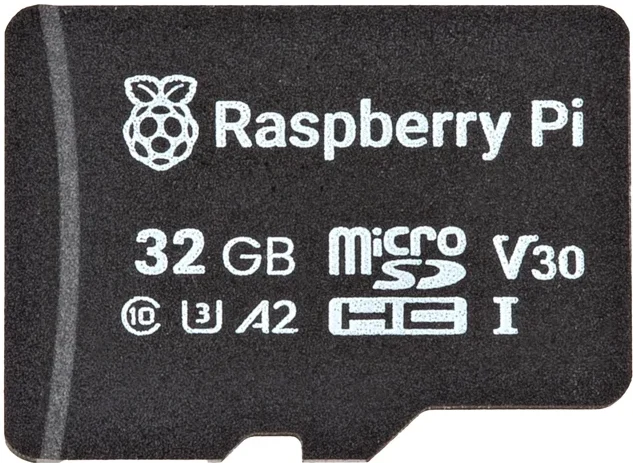
Raspberry Pi is the brand name established by the Raspberry Pi Foundation in 2009, and is probably one of the best-known single-board computer (SBC) makers. They are probably better known as a consumer of microSD cards rather than a manufacturer — as virtually all of their boards (from the Model B+ onwards) have used microSD cards as their primary storage — but they decided to launch their own line of microSD cards after experiencing dissatisfaction with other cards on the market.
This card was suggested to me by Reddit user u/rathersadgay (link). I picked these up from PiShop.us, and I have to say — these came in the most minimalist packaging I’ve seen to date — just a tiny plastic baggie. I almost missed it when opening the bubble mailer that it arrived in because it was so small and so light. (I guess cutting out the packaging is one way to save on cost?) As far as cost — these cards are the second-most expensive 32GB I’ve purchased so far (as of the time of this writing). However, if they perform well and endure well, then the price may be worth it.
These cards meet all the criteria that I set out for determining what’s considered a name-brand card, so I’ve lumped these cards in with the name-brand cards in my result set.
On the performance front — sequential read, random read, and random write speeds were all above average, with random write speeds being this card’s strong suit. However, sequential write speeds were below average. These cards bear the Class 10, U3, V30, and A2 marks; performance measurements were good enough for the Class 10 mark, but were not good enough for any of the other marks. (Individually, samples #2 and #3 did well enough to qualify for the U3 and V30 marks, but the overall average between the three samples wasn’t good enough to qualify for them.) However, I’ll throw in my standard disclaimer — my performance testing methods do not align with those prescribed by the SD specification; it’s possible that these cards would have performed better had they been tested under proper conditions. (In particular, Raspberry Pi claims that they worked with Longsys to make sure that these cards support command queueing — which my readers don’t support — so it’s very possible that they would have done better had they been tested using a reader that supported command queueing, and they’ve made sure that it’s supported in both the hardware and the Linux kernel for the Raspberry Pi 5.)
On the endurance testing front:
- Sample #1 has survived 14,851 read/write cycles so far and has not yet experienced any errors.
- Sample #2 has survived 14,306 read/write cycles so far and has not yet experienced any errors.
- Sample #3 has survived 9,961 read/write cycles so far and has not yet experienced any errors.
Overall? It’s too early to make any judgment calls on endurance, but we can still look at other factors. These cards did well on skimp, and they were a little above average in terms of performance — but they’re pretty pricey. I’m not sure that I would get these if I were just looking for a general purpose card. But if you plan on using it in a Raspberry Pi 5? If these cards actually do a better job in an RPi5 (compared to other cards), then the extra cost might be worth it. Unfortunately, I don’t have any RPi5’s to test them with, so I can’t say whether or not they actually do a better job.
November 8, 2025 (current number of read/write cycles updates automatically every hour)