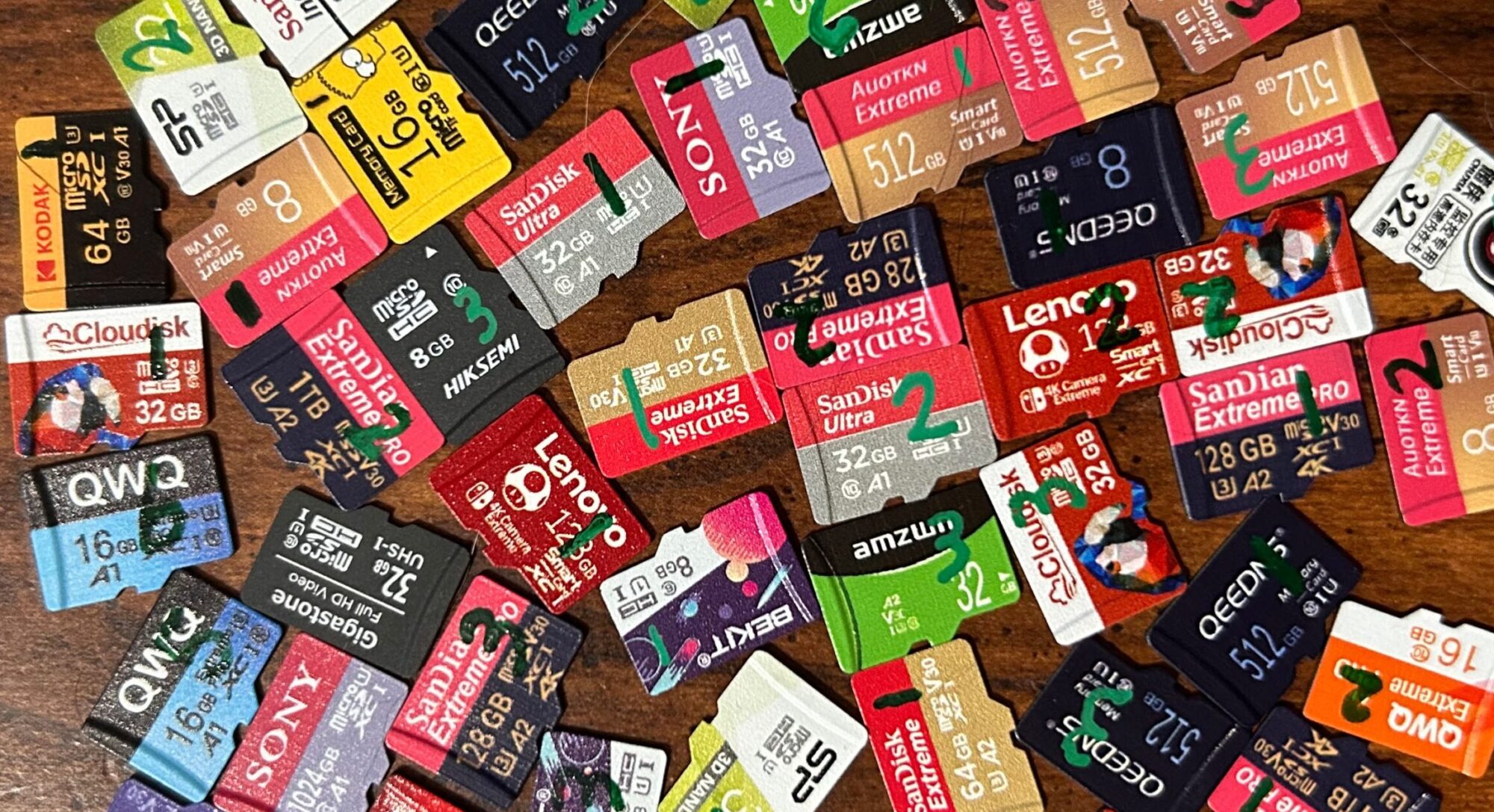
I’ve been doing endurance testing on microSD cards for 2 1/2 years now. I’ve gotten coverage in publications such as TechRadar, TechSpot, Tom’s Hardware, IGN, and numerous social media posts. I’ve destroyed over 150 cards from over 30 different brands — and I have over 100 cards from 30 different brands that are going through endurance testing right now — to see just how long they will last when put under load. I’ve created a browsable database of my data for all to see.
All of this is to say that I’d like to think I know what I’m talking about. So believe me when I say that you have a problem with your microSD cards.
It didn’t start out this way. Before I started this project, SanDisk was my go-to for microSD cards: they were cheap, they were readily available, and — at least, in my mind — they had been rock-solid. I used them with all of my single-board computers. I had built my own “redneck supercomputer” — a cluster of over 35 single-board computers who all used SanDisk Ultras as their primary storage — and hadn’t had any issues with them.
Then, one day, one of them failed. And out of all of them, this was the worst one that could have failed.
Several years back, I created a bot for Wikipedia that searched for cut-and-paste moves — a type of move where a user cuts the content from one page, pastes it into another, and then turns the original page into a redirect to the new page. It’s undesirable because this splits the history of the page in two, leaving any contributions made by others behind at the old page — meaning that if anyone needs to, say, build a list of all the people who contributed to a given page, they won’t see all of the people who contributed to that page before the cut-and-paste move happened. It’s also undesirable because the talk page doesn’t get automatically moved with it — meaning that if there was a discussion about the page’s content that was taking place when the cut-and-paste move happened, users who stumble upon the page won’t see the old talk page. It’ll essentially be orphaned, sitting in a corner that most users will never see. My bot crawled through Wikipedia looking for these cut-and-paste moves, generating reports of what it found so that administrators could go in and fix them.
The source code for that bot was on that microSD card. I didn’t have a backup of it anywhere. It’s likely gone forever.
But that was just a single data point. At the time, I took it as an anomaly — I had just gotten extremely unlucky. All storage media goes bad eventually — some sooner than others. I knew that. I kicked myself for not having a backup of the bot’s source code anywhere. But I moved on.
Then I started doing endurance testing on microSD cards. It had nothing to do with that earlier failure — my motives were completely unrelated to it. I wanted data on as many brands and as many models as I could afford — major brands, minor brands, and knockoffs alike — and I wanted SanDisk to be included in that. I purchased a number of SanDisk cards — different models, at different times, from different sources, including models that I had no previous experience with. Others purchased some and donated them to me. All in all, I have over 40 SanDisk cards in my collection.
As time wore on, more data points started to pile up. Cards started failing under circumstances where no other card failed. And those failures were primarily from SanDisk cards.
One day in February 2024, I plugged a new card reader into one of my USB hubs. Two SanDisk Ultra 32GB’s — that were on card readers in neighboring USB ports on the same hub — suddenly stopped working. None of the other cards on that hub were affected.
One day in May 2024, a circuit breaker tripped. All of the machines I use for testing lost power. I reset the circuit breaker and started bringing my test rigs back up. Of all the cards I was testing at that time, only one stopped working: a SanDisk Extreme 32GB.
One day in July 2024, I gracefully shut down some of my test rigs so that I could move some things around. When I powered them back up, a SanDisk Extreme 64GB and a SanDisk Extreme PRO 64GB — that were plugged into two different machines — had stopped working. None of my other cards were affected.
One day in October 2024, one of my USB hubs started having issues and needed to be reset. Of the cards that were plugged into that hub, only one card wouldn’t work after the reset: a WD Purple 32GB. Two weeks later, another WD Purple 32GB died under similar circumstances — followed two months later by the last of my WD Purple 32GB’s and another SanDisk Extreme PRO 64GB in July 2025. In each instance, none of the other cards on that same machine were affected.
One day in September 2025, I ran a software update on one of my testing rigs. The update required a reboot — I didn’t even need to power anything down. After the reboot was complete, all of the cards I had hooked up to that machine restarted successfully — that is, except for a SanDisk ImageMate PRO 128GB.
Then one day in April 2026, I pulled all of my card readers from two of my test rigs — so that I could replace the power supplies to the two hubs I was using with them with a single Mean Well power supply. When I got done, only one card (out of the 16 that were plugged into those two hubs) had issues: another SanDisk ImageMate PRO 128GB quit working. (And before you say “it’s because you pulled it from the hub while it was running”, let me point you to page 3 of the SD Physical Layer Specification — it doesn’t really matter what version, because it’s on page 3 in pretty much every version going back to at least version 3.01 — where it says “Card removal during read operation will never harm the content”. That specification has your name at the top of every single page. And I made sure to check that my testing program was only doing read operations before pulling any of them.)
Just a week after that, I pulled all of my card readers from those same two test rigs so that I could mount everything up to some DIN rails — except this time, I gracefully shut down the host machines first, disconnected the hub from the host machine, and pulled power from the hub before pulling any of the card readers from the hub. And when I finished, reconnected everything and powered everything back up, guess which card was the only one that wasn’t working? The last of my SanDisk ImageMate PRO 128GB’s.
Out of the 38 SanDisk cards currently in my study, 12 have died under dubious circumstances — circumstances that seem to involve possible power disturbances or brownouts. That’s almost 1 out of every 3 cards — a disturbingly high ratio for a major name brand. No other brand in my collection has had this same issue — or at least, not to the extent that SanDisk has. These failures have happened on different machines, with different hardware, using different USB hubs made by different manufacturers. In fact, the only thing they seem to have in common is the model of card reader that I use — but none of my other cards have had issues with them.
Others — such as embeddedTS — have written about this issue before; and though they were referring to SD cards in general, the fact that they mentioned it on a page where they were talking about testing 40 SanDisk microSD cards makes me suspect that SanDisk cards made up a significant portion of the failures they saw.
And sure — failures happen. All storage media fails eventually. That’s the whole point of this project — to see just how long you’ll last before that happens. And excluding these failures, your cards are doing just fine — in fact, you’re a little bit above average. But these failures are dragging you down to where you’re below average. It’s enough of a problem that I don’t recommend SanDisk cards to the people that I talk to.
So SanDisk, here’s my request to you: figure out why this happens and fix it. I’m willing to help however I can: I can provide you specifics on some of the cards I’ve experienced issues with. I can provide samples of some of my dead cards for analysis. I can provide specifics on my testing methods. I can test some new cards to help you determine whether you’ve fixed the issue. You have an opportunity here to dramatically improve the quality of your products — don’t just let this go, or you’ll cement your reputation as just a second-rate manufacturer.
Sincerely,
Matt Cole